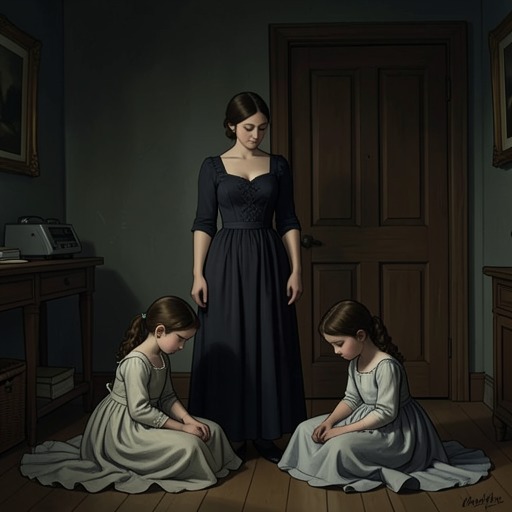
Estha’s traumatic silence
The God of Small ThingsEstha’s traumatic silence is not simply an absence of speech but a visible form of withdrawal, bound to the twins’ separation and to a past they cannot turn into a story of clear innocence and guilt. When Rahel returns to Ayemenem, he does not look up; later she watches him through a barred window, each twin alone on one side of the light. Their inability to speak their shared experience is part of its continuing force: what cannot be settled as testimony or anger must still be carried.
Silence and Withdrawal
In Pappachi’s study, Estha’s mind is described as full of trains. He blocks the light from the door, becoming an “Estha-shaped Hole in the Universe.” The image makes withdrawal spatial: rather than merely declining conversation, he seems to occupy the room as an absence, a shape formed by what has been shut out. The detail belongs to Rahel’s return and her attempt to find him again; she is near him, but the image offers no easy access to his thoughts.
The force of this silence is clarified by the language of return. Estha has been sent away, and the word “Returned” slips into conversation as if he were something borrowed and given back. The comparison to library books makes the twins’ separation sound like an administrative transaction, while the emotional rupture it caused remains unresolved. His retreat is therefore situated within a history of imposed separation, not presented as an isolated trait.
The Twins’ Unfinished Reunion
The estrangement persists in the domestic spaces they share. In Pappachi’s study, Rahel looks up from a Wisdom Exercise Notebook and sees that Estha has gone. She climbs down from the stool and table and walks out to the verandah, where she sees his back disappearing through the gate. The movement is brief but decisive: even after Rahel has returned, the reunion does not immediately become conversation or companionship. She is left watching him leave again.
Later, the separation takes the form of a window. Rahel sees Estha sitting on his neat bed, looking out through the bars at the darkness; he cannot see her outside, where she sits looking in at the light. The scene reverses their positions without bringing them together. One twin is framed inside, the other outside, and the barrier makes their mutual presence visible while preserving their distance.
Shared Grief and the Question of Blame
The narration figures the twins as actors trapped in a play with no discernible plot, stumbling through parts and tending grief that seems to belong to someone else. Their condition is not simply that they lack an explanation; they cannot change the roles through which the past continues to reach them. The theatrical image describes a life still governed by an event whose meaning has not become manageable or complete.
The possibility of naming them victims is raised and then withheld. The passage imagines that a counselor might tell them they were children without control, victims rather than perpetrators. Such a declaration could give them a face to direct anger toward, permit them to seek redress, and perhaps help them exorcise haunting memories. But the thought remains conditional: the narration says that it would have helped if they could have made that crossing into victimhood. No neat therapeutic resolution follows.
Instead, anger is unavailable, and the twins have no face for the “Other Thing” they hold in their “sticky Other Hands,” like an imaginary orange. The burden cannot be laid down or given away; it must be held carefully and forever. That image gives Estha’s silence a shared dimension. The twins’ inability to convert the past into a clean account of blame leaves them carrying it together, even when the scenes show them physically apart.
The account does not erase responsibility: Estha and Rahel know that there were several perpetrators besides themselves, but only one victim. This distinction keeps their self-implication from becoming a claim that the harm was theirs alone. Their silence and grief persist in the space between those facts, without the anger or redress that might have supplied a simpler ending. Estha’s withdrawal thus marks both the lasting injury of separation and the difficulty of speaking from inside a history in which the children were not its only agents, and its victim was singular.